


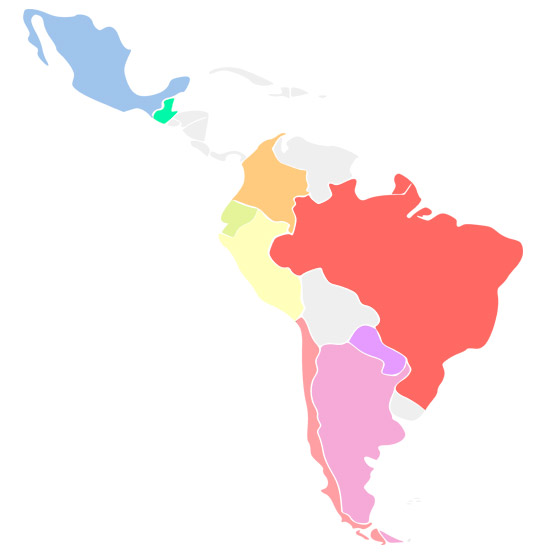
Number of LATAM bills of law between January 2025 and April 2026
| COUNTRIES | PROJECTS | |
|---|---|---|
| ARGENTINA | 63 | |
| BRAZIL | 36 | |
| CHILE | 16 | |
| COLOMBIA | 14 | |
| ECUADOR | 5 | |
| GUATEMALA | 1 | |
| MEXICO | 35 | |
| PARAGUAY | 14 | |
| PERU | 17 |
Topics of the bills presented between January 2025 and April 2026
| Freedom of expression and political rights | 19.9 % | |
| Discrimination, violence and hate speech | 15.4 % | |
| Protection of minors | 11.4 % | |
| Privacy and ARCO rights | 7.5 % | |
| Artificial Intelligence | 7.0 % | |
| Consumer rights | 5.0 % |
| Honor and reputation | 5.0 % | |
| Cybersecurity | 4.0 % | |
| Content Moderation and Liability of Intermediaries | 3.5 % | |
| Access to information | 2.5 % | |
| Public order | 2.5 % | |
| Public Morality | 2.0 % | |
| Intellectual Property | 2.0 % |
Topics of the bills presented between January 2025 and April 2025
| Freedom of Expression and Political Rights | 19.9 % | |
| Discrimination, violence and hate speech | 15.4 % | |
| Protection of minors | 11.4 % | |
| Privacy and ARCO rights | 7.5 % | |
| Artificial intelligence | 7.0 % | |
| Consumer rights | 5.0 % | |
| Honor and reputation | 5.0 % | |
| Cybersecurity | 4.0 % | |
| Content moderation | 3.5 % | |
| Access to information | 2.5 % | |
| Public order | 2.5 % | |
| Intellectual Property | 2.0 % | |
| Public Morality | 2.0 % | |
| Others | 11.0 % |
04/04
National Deputy Diego Giuliano (UxP) presented a motion to the Chamber of Deputies bill To regulate artificial intelligence in Argentina, based on the European AI Act model, the initiative proposes the creation of a National Registry of Artificial Intelligence Systems, defines principles of transparency, non-discrimination, and human oversight, and seeks to prevent AI from becoming a tool for mass surveillance. The project has a direct impact on digital rights, freedom of expression, and privacy in a context of increasing use of automated systems in social and communication decisions.
ARTIFICIAL INTELLIGENCE DIGITAL RIGHTS
08/04
was presented on Bill 0253-D-2026 This law establishes a national regime for sovereign artificial intelligence and introduces amendments to the Criminal Code regarding public algorithm systems. The text regulates the lifecycle of AI systems, includes a risk-level classification (with prohibitions for unacceptable uses and reinforced obligations for high-risk AI and general-purpose models), creates the National Artificial Intelligence Agency (ANIA), and incorporates duties of explainability and human oversight. While the focus is on technological governance and digital sovereignty, its provisions on public algorithms and generative models have direct implications for the flow of information and freedom of expression online.
ARTIFICIAL INTELLIGENCE DIGITAL RIGHTS
23/04
The government of Javier Milei He banned all accredited journalists from entering the Casa Rosada.This unprecedented measure in a democratic context affected some 60 reporters from national and international media outlets. The decision was made following a criminal complaint filed by the Presidential Guard against two journalists from the news channel TN for filming inside the government headquarters. The Buenos Aires Press Union (SiPreBa) condemned the measure as an act of censorship and framed it as part of the president's escalating harassment of journalists. The press room remained closed for eleven days.
FREEDOM OF THE PRESS CENSORSHIP
28/04
The Minister of Deregulation and Transformation, Federico Sturzenegger, announced a reform to the Companies Act This would allow the creation of "artificial intelligence companies," defined as businesses without human components that would operate entirely through algorithms. The proposal is part of a package of six bills that the Executive Branch will send to Congress. The initiative raises unprecedented questions about attributing responsibility for content and decisions generated by autonomous systems, with significant implications for regulating the digital environment, automated expression, and the rights of individuals in relation to non-human actors.
ARTIFICIAL INTELLIGENCE DIGITAL PLATFORMS
02/04
The Latin American Internet Association (ALAI) presented a proposal to the Commission on Future, Science, Technology, Knowledge and Innovation of the Chamber of Deputies. document with observations ALAI (the Argentine Association of Journalists) issued a statement regarding the Bill regulating the creation and dissemination of realistic digital imitations using AI (Bill 17795-19, concerning deepfakes). ALAI warned that the bill, in its current form, could establish a mechanism of prior censorship by allowing the removal of content without substantive judicial review, through "notice and takedown" schemes based on administrative complaints. The document argues that the initiative, as currently drafted, violates freedom of expression, particularly regarding criticism of authorities and public figures.
ARTIFICIAL INTELLIGENCE FREEDOM OF EXPRESSION DIGITAL PLATFORMS
08/04
The Minister of Science, Ximena Lincolao, was physically assaulted During a visit to the Austral University of Chile in Valdivia, the government announced a lawsuit for "attack against authority" and strongly condemned the violence. The incident, which occurred in an academic setting, sparked debate about the boundaries between the right to protest and political violence, as well as about media coverage of demonstrations on university campuses and the safety of those participating in public discourse.
FREEDOM OF EXPRESSION RIGHT TO PROTEST
23/04
The Office of the Special Rapporteur for Freedom of Expression of the IACHR published its 2025 Annual ReportThe report ranked Chile 70th in Reporters Without Borders' global ranking, marking one of its lowest positions in decades. The report highlighted the need to strengthen protection mechanisms for journalists and review legal frameworks that may inhibit critical journalism, within a regional context of widespread erosion of guarantees for freedom of expression.
FREEDOM OF THE PRESS
23/04
The Inter-American Press Association (IAPA) presented, within the framework of its virtual Mid-Year Meeting 2026, his report on the regional situation of press freedomThe report, which included Paraguay among the countries whose leaders emerged from free elections but opted for a marked confrontation with the press, documents statements by President Santiago Peña against journalists and critical media outlets, restrictions on access to sources, limitations on asking questions at official events, and public denigration, as well as patterns of judicial and administrative pressure against individuals linked to critical media.
FREEDOM OF THE PRESS ACCESS TO INFORMATION
26/04
In the context of Paraguayan Journalist Day, the Paraguayan Journalists' Union (SPP) and various unions They expressed concern about the climate of official hostility toward journalism, reminding President Peña that obstructing journalistic work constitutes a form of censorship and violates fundamental principles of freedom of expression and of the press guaranteed by the National Constitution. The criticism came amid recent tensions between the president and journalists accredited to the Presidency, as well as an episode of hostile presidential statements against business leaders and media outlets.
FREEDOM OF THE PRESS
27/04
The Ministry of Information and Communication Technologies (MITIC) issued a statement through CERTpy In response to the identification of cases of misuse of digital content that could damage institutional image and cause confusion, the government announced it would be handling complaints and urged citizens to report similar cases. This incident reopened the debate about the boundaries between preventing fraud with synthetic content, protecting the institution's image, and the risks of developing digital content control mechanisms that could affect freedom of expression.
DIGITAL PLATFORMS DIGITAL CONTENT
11/04
The Attorney General's Office issued the 00119 2026 resolution ofThe directive establishes guidelines for investigating crimes and threats against journalists, media workers, and other media professionals. It incorporates more rigorous standards and a differentiated approach to these offenses, recognizing that attacks against the press directly impact the right to freedom of expression, access to information, and public debate. The investigative body emphasized that investigations must consider both the attack suffered and the facts the journalist had been reporting or verifying in the course of their work.
FREEDOM OF THE PRESS ACCESS TO INFORMATION
24/04
The Foundation for Press Freedom (FLIP) presented its annual report 2025The report documents 469 attacks against journalists in Colombia. Director Sofía Jaramillo warned that the stigmatizing rhetoric of public figures is escalating into real and direct threats, especially in regions like Arauca, Caquetá, and Norte de Santander, where it has resulted in physical intimidation and forced displacement. The report also highlights the shortcomings in the regulation of technologies such as artificial intelligence and digital harassment against women journalists, and coincides with the IACHR's inclusion of Colombia among the countries where practicing journalism has become a high-risk profession.
FREEDOM OF THE PRESS DIGITAL VIOLENCE
29/04
Presidential candidate Paloma Valencia (Democratic Center) published a "debate" generated with artificial intelligence The campaign featured digital versions of his opponents Iván Cepeda and Abelardo de la Espriella, without either of them actually participating. This strategy sparked a debate about the ethical limits of using AI in political campaigns and about the non-consensual digital recreation of public figures, in an electoral context marked by growing concerns about deepfakes, disinformation, and manipulation of public discourse on digital platforms.
ARTIFICIAL INTELLIGENCE ELECTORAL DIGITAL CONTENT
22/04
Fundamedios posted a statement The report warns of the accelerated deterioration of the media and journalistic ecosystem in Ecuador. The organization describes an environment marked by opacity, precariousness, violence, organized disinformation, and the infiltration of actors who instrumentalize communication for political ends. It also points out that both the central and local governments have contributed, through action or omission, to deepening the vulnerability of journalists through practices of harassment, concealment of information, and discriminatory treatment based on editorial stance.
FREEDOM OF THE PRESS DISINFORMATION
23/04
The Office of the Special Rapporteur for Freedom of Expression of the IACHR published its 2025 Annual ReportThe report warns of a serious deterioration in the conditions for practicing journalism and freedom of expression in Ecuador. It documents at least six murders of journalists possibly linked to their work, the suspension of community media outlets (TVMICC, Radio Ilumán, Radio Inti Pacha), cyberattacks, the removal of content through copyright claims, the use of deepfakes, and internet and telephone service disruptions during protests. The RELE also expressed concern about the entry into force of the Organic Law of Social Transparency ("Foundations Law") due to its potential effects on civil society.
FREEDOM OF THE PRESS DIGITAL CONTENT ACCESS TO INFORMATION
30/04
The First Court of the Specialized Civil Chamber of the Provincial Court of Guayas issued a ruling against Fundamedios In a habeas data action filed by businessman Pedro Julio Bejarano, the court ordered the removal of an alert regarding the safety of journalists and the issuance of a public apology. The Inter American Press Association (IAPA), the Committee to Protect Journalists (CPJ), the Voices of the South Network, and the IFEX-LAC network categorically rejected the ruling, warning that it transforms habeas data into a mechanism for suppressing information of public interest and persecutes those who document litigation against the press. The decision sets a worrying precedent for organizations that monitor restrictions on freedom of expression.
FREEDOM OF THE PRESS ACCESS TO INFORMATION
10/04
The Guatemalan Journalists Association (APG) issued statements on the state of freedom of expression in the country, in an assessment that perceives a setback in respect for journalistic practice during the five-year period 2020-2025. The APG insisted on the need for the authorities to promptly investigate crimes against journalists and to guarantee an environment free of judicial harassment, in a context where threats, criminalization and hate campaigns on social networks against independent and exiled journalists persist.
FREEDOM OF THE PRESS
26/04
The journalist Carlos Humberto Cal Ical, member of the Association of Journalists and Social Communicators of Alta Verapaz (APC-AV), He was shot to death on a road in the municipality of San Cristóbal Verapaz. Cal Ical practiced journalism through social media and, according to the APC-AV, his murder is part of a pattern of systematic persecution against independent journalism in Guatemala, particularly in regions where social and environmental conflicts are covered. The IAPA condemned the crime and demanded a thorough investigation to prevent it from adding to the cycle of impunity that plagues the press in the country.
FREEDOM OF THE PRESS VIOLENCE AGAINST JOURNALISTS
29/04
The Inter American Press Association (IAPA) He condemned the murder of journalist Cal Ical The IAPA urged the Guatemalan government to conduct a transparent investigation and implement effective protection measures for the press. In its semiannual report, the IAPA warned that attacks against journalists in digital environments persist in Guatemala, including harassment, threats, and risks of judicial persecution related to coverage of sensitive issues, and that the survival of independent journalism depends more on social resistance and international pressure than on state guarantees.
FREEDOM OF THE PRESS VIOLENCE AGAINST JOURNALISTS
14/04
The Supreme Court of Justice of the Nation (SCJN) declared it unconstitutional, with six votes in favorArticle 480 of the Puebla Penal Code, which defined the crime of "cyber harassment," was struck down by the Supreme Court of Justice of the Nation (SCJN). The Court argued that the wording violated the principles of legal certainty and minimal criminal intervention, opened the door to arbitrary applications, and could have a chilling effect on freedom of expression on social media, as it was unclear what conduct was prohibited. The ruling has retroactive effect for those who have been prosecuted for this crime since its enactment in July 2025.
FREEDOM OF EXPRESSION DIGITAL CONTENT
11/04
The organization Article 19 published the short film "Bullet Machine" As part of a campaign leading up to World Press Freedom Day, the organization aimed to raise awareness of the violence faced by journalists in Mexico and the impact on their families. The organization noted that it has documented 176 murders of journalists and 31 disappearances in the last six years, warning that Mexico remains the most dangerous country for the press without a declared war, with nearly 80% of cases going unpunished.
FREEDOM OF THE PRESS VIOLENCE AGAINST JOURNALISTS
13/04
The Chamber of Deputies continued the debate on electoral reform Introduced by Mayor Claudia Sheinbaum, the bill includes provisions for labeling electoral content generated or altered with artificial intelligence. The initiative requires broadcasters, radio and television concessionaires, and digital platforms to identify synthetic content and prevent its dissemination when it is not labeled. It also empowers the National Electoral Institute (INE) to order the removal of content identified as bots or AI-generated material. Experts warned of technical challenges and risks to freedom of expression, particularly regarding the definition of "technological manipulation" and the discretionary powers of the electoral body.
ARTIFICIAL INTELLIGENCE ELECTORAL DIGITAL PLATFORMS
20/03
The Ministry of Justice and Public Security (MJSP) opened a public consultation to improve the drafting of the Guide to the ethical use of artificial intelligenceSpecifically, the guide aims to educate the public on the use of artificial intelligence, addressing its potential, risks, and users' rights and responsibilities, as well as issues such as transparency, non-discrimination, accountability, security, and respect for fundamental rights. The consultation is open to contributions at the Participatory Brazil Platform until April 19.
ARTIFICIAL INTELLIGENCE
24/03
The Federal Senate approved the Bill No. 896/2023, presented by Senator Ana Paula Lobato (PSB/MA), which includes misogyny as a form of discrimination crime, equating it to other discriminatory conduct foreseen in the Law No. 7.716/1989The text defines misogyny as behavior that expresses hatred or aversion toward women, and it establishes the criminalization of defamation and incitement to discrimination based on misogyny. Furthermore, the bill increases penalties for crimes against honor when committed against women in the context of domestic and family violence. The measure is part of a broader effort. context The bill strengthens legislation aimed at protecting women, given the widespread dissemination of misogynistic rhetoric on social media and in public spaces. Following its approval, the proposal will now be reviewed by the Chamber of Deputies.
DISCRIMINATION GENDER VIOLENCE CRIMES AGAINST HONOR
25/03
was presented on Bill No. 1.390/2026The bill, authored by federal deputy Félix Mendonça Júnior (PDT/BA), proposes the suspension of access to social media as a consequence of a conviction for intentional crimes involving violence or serious threats, especially in cases of gender-based violence. The measure may be applied by judicial decision in cases such as femicide, harassment, crimes against sexual dignity, and crimes committed with violence or serious threats due to the victim's emotional or sentimental rejection, provided it is demonstrated that the use of the platforms poses a risk to the victim. The suspension may last until the end of the sentence, with the accounts being blocked and the platforms being obligated to implement mechanisms to prevent the recreation of profiles. According to the bill's justification, the measure seeks to reduce the use of social media as an instrument of violence and prevent the amplification and undue notoriety of aggressors in the digital environment.
GENDER VIOLENCE DIGITAL PLATFORMS
31/03
was presented on Bill No. 1.542/2026The bill, authored by federal deputy Lucas Abrahao (REDE/AP), establishes the Framework for Liability for Autonomous Systems, setting standards for civil and administrative liability for damages caused by artificial intelligence (AI) systems. The proposal establishes a system of strict and joint liability among developers, providers, and operators of autonomous systems, regardless of proof of fault. The text also classifies systems by risk levels and prohibits applications deemed unacceptably risky, such as those that subliminally manipulate behavior or violate fundamental rights. Among other provisions, the bill guarantees user rights, such as the right to explanation and to challenge automated decisions, and includes measures such as mandatory insurance for high-risk systems. According to the explanatory memorandum, the proposal aims to increase legal certainty and align Brazil with international best practices in the regulation of artificial intelligence.
ARTIFICIAL INTELLIGENCE
14/04
was presented on Bill No. 1.825/2026, authored by federal deputy Mario Frias (PL/SP), whose objective is to modify the Digital Statute of Children and Adolescents (Law No. 15.211/2025 – Digital ECA) to limit the general obligations of digital platforms to monitor and moderate user-generated content. Among other measures, the proposal establishes that the removal, blocking, or demonetization of content deemed lawful will depend on a court order, amending sections II and III of Article 8 of the law. Furthermore, it repeals provisions that impose content filtering obligations, generalized user monitoring, or the restriction of lawful content based on risk assessments. According to the explanatory memorandum, the proposal aims to revise provisions of the Digital ECA considered overly broad, balancing the protection of children and adolescents with the guarantee of fundamental rights and economic activity.
DIGITAL PLATFORMS PROTECTION OF MINORS
14/04
According to the Migalhas websiteThe Third Chamber of the High Court of Justice (STJ) unanimously upheld the ruling ordering platform X to remove offensive posts targeting underage influencers based on hashtags to identify the content, without needing to specify individual URLs. Following the ruling ordering the content removal, the platform argued in the Special Resource No. 2.239.457 the requirement to specifically indicate the links for content removal and the provider's responsibility, pursuant to Article 19 of Internet Civil Rights FrameworkIn analyzing the case, Justice Nancy Andrighi, the presiding judge, emphasized that, given the massive circulation of illicit publications involving children and adolescents, individually identifying each publication can be impractical and compromise the effectiveness of judicial protection. The court considered that, in this context, hashtags function as indexing markers capable of delimiting the core of dissemination of illicit content, thus enabling the adoption of appropriate removal measures. The decision is also based on the recent ruling of the Federal Supreme Court regarding Article 19 of the [relevant legislation]. Internet Civil Rights Framework (Topic 987 y Topic 533) and in the duties of protection reinforced by the Digital Statute of Childhood and Adolescence.
PROTECTION OF MINORS LIABILITY OF INTERMEDIARIES DIGITAL PLATFORMS
07/04
Congressman Fernando Rospigliosi He was sentenced to nine months of suspended imprisonment. for the crime of defamation against the former Attorney General, Delia Espinoza. The lawsuit originated after a post made by Rospigliosi on July 7, 2026, on his “X” account, in which he described Delia Espinoza as an “ally of terrorism and illegal economies.”
DEFAMATION
10/04
Prior to the General Elections of April 12, 2026, the National Association of Journalists (ANP) It recorded 61 attacks on journalists during the election campaignIn its preliminary report, it reveals that stigmatizing discourse is the main form of aggression, followed by physical and verbal attacks, threats, harassment and a cyberattack; with the candidates being the most responsible for these violations.
ELECTORAL FREEDOM OF THE PRESS
11/04
The Disinformation Observatory: Mission Peru published a report The report documented 140 incidents of disinformation in the context of elections, revealing that platform X accounts for almost half of all disinformation circulating, which is primarily directed against candidates and political actors. The report identifies that political elites themselves are using lies as their main tool for garnering votes and that a campaign to preemptively delegitimize electoral bodies is underway to lay the groundwork for the undemocratic rejection of election results.
ELECTORAL DISINFORMATION
