


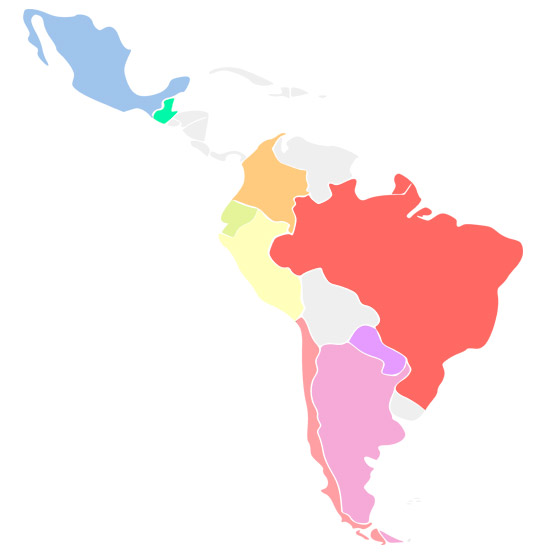
Number of LATAM projects between January 2025 and June 2025
| COUNTRIES | PROJECTS | |
|---|---|---|
| ARGENTINA | 19 | |
| BRAZIL | 8 | |
| CHILE | 9 | |
| COLOMBIA | 3 | |
| ECUADOR | 4 | |
| GUATEMALA | 1 | |
| MEXICO | 8 | |
| PARAGUAY | 11 | |
| PERU | 4 |
Topics of bills introduced between January 2025 and June 2025
| Freedom of expression and political rights | 16.7 % | |
| Privacy and ARCO rights | 16.7 % | |
| Protection of minors | 11.1 % | |
| Discrimination, violence and hate speech | 9.3 % | |
| Cybersecurity | 7.4 % | |
| Artificial Intelligence | 7.4 % |
| Access to information | 3.7 % | |
| Internet Access and Infrastructure | 3.7 % | |
| Apologia | 3.7 % | |
| Misinformation | 3.7 % | |
| DESC | 1.9 % | |
| Bullying | 1.5 % | |
| Official advertising | 1.4 % |
Topics of bills introduced between January 2024 and June 2025
| Freedom of Expression and Political Rights | 16.7 % | |
| Discrimination, violence and hate speech | 11.8 % | |
| Children's rights | 12.5 % | |
| Access to information | 7.8 % | |
| Consumer rights | 4.2 % | |
| Privacy and ARCO Rights | 9.2 % | |
| Honor and reputation | 5.9 % | |
| Misinformation | 4.6 % | |
| Artificial intelligence | 5.2 % | |
| Public morality | 4.9 % |
21/07
Deputy Gerardo Milman presented the Bill No. 3904-D-2025 This bill modifies Article 2 of Law No. 26.637, with the aim of adapting the regulatory framework to the current risks of financial cybercrime. The initiative repeals the general ban on the use of mobile phones in banking institutions and eliminates the use of signal jammers, allowing their controlled use as an authentication tool. It also incorporates a specific catalog of cybercrimes such as phishing, ransomware, deepfakes, and biometric data manipulation, and establishes obligations for financial institutions regarding cybersecurity and traceability.
PERSONAL DETAILS CYBERSECURITY
17/07
Senators presented the Bill No. S-1253/25 Comprehensive protection to prevent, punish, and eradicate digital violence. The bill seeks to expand protections against digital violence to all individuals, beyond the current Olimpia Law 27.736, which is limited to gender-based violence. It defines forms of cyberbullying, sexual extortion, non-consensual dissemination of intimate content, grooming, and doxing. It establishes free civil proceedings, urgent preventive measures, including the immediate deletion of digital material, and establishes new criminal offenses. It also amends articles of the Penal Code, incorporating penalties for digital harassment, slander and libel by digital means, and non-consensual dissemination of sexual content.
DIGITAL VIOLENCE CONTENT MODERATION
14/07
Senators presented the Bill S-1226/25 "LAW PROHIBITING THE SALE, ADVERTISING, AND PROMOTION OF ELECTRONIC NICOTINE DELIVERY DEVICES TO MINORS (VAPERS)." The bill prohibits the sale of vapers to minors under 18 years of age and establishes a total ban on "all forms of advertising, promotion, and sponsorship, direct or indirect," of these devices. The law specifically includes restrictions on "social networks, digital platforms, print and audiovisual media, events, gifts, or other types of incentives" and prohibits visible display at points of sale. It also contemplates sanctions that include fines, closures, and confiscation of products.
ADVERTISING PROTECTION OF MINORS
11/07
Various deputies presented the Bill 3728-D-2025 This bill addresses the prevention of electoral disinformation using AI. The bill modifies the National Electoral Code to prohibit the use of AI to generate, alter, or synthesize digital content for the purpose of influencing electoral processes through identity theft, false attribution of statements, creation of false content about electoral events, and dissemination of misleading information. It empowers electoral authorities to judicially order the suspension, de-indexing, blocking, or removal of prohibited content, requiring the collaboration of internet intermediaries. It establishes prison sentences of two months to three years. The bill seeks to balance protection against disinformation with the preservation of freedom of expression, excluding artistic, satirical, or hypothetical works.
DISINFORMATION ARTIFICIAL INTELLIGENCE
11/07
It was presented before the Chamber of Deputies on Bill No. 3727-D-2025 This law creates the National System for the Protection of Human Rights Defenders (SINAPPEDHU) and establishes specific protection measures for journalists, social communicators, photographers, cameramen, and photojournalists who disseminate information on human rights. The law guarantees the right to freely disseminate, publish, and express opinions and information without limitations, establishes reporting channels for threats, and mandates protection measures based on risk assessments. It also creates a National Advisory Council composed of representatives of the State and civil society, and requires all authorities to cooperate with the protection system.
FREEDOM OF EXPRESSION
10/07
Deputy Gerardo Milman presented the Bill No. 3684-D-2025The bill modifies Law 27.736 ("Olimpia Law") to expressly incorporate the use of artificial intelligence as a specific form of digital gender-based violence. The proposal criminalizes the non-consensual creation and dissemination of sexual images generated or manipulated using AI (deepfakes), including "real, totally or partially false, edited, intimate, or nude" material.
ARTIFICIAL INTELLIGENCE CONTENT MODERATION DIGITAL VIOLENCE
04/07
Deputies Natalia Sarapura and Danya Tavela presented the Bill No. 3558-D-2025 This law regulates the use of artificial intelligence in the generation of voiceovers and audiovisual productions on radio, television, and digital platforms. It establishes the obligation to explicitly identify when AI-generated voices are used, creates a National Registry of Synthetic Voices in ENACOM, and prohibits the unauthorized replication of professional voices. The law applies to audiovisual advertising, informational and entertainment content, and productions intended for public exhibition. It includes penalties of up to 1.000 minimum wages and empowers ENACOM as the enforcement authority.
ARTIFICIAL INTELLIGENCE CONTENT REGULATION
03/07
Representative Silvana Giudici presented the Bill 3540-D-2025, which proposes amending Law 25.326 on Personal Data Protection to incorporate specific criteria for regulating artificial intelligence systems. The initiative establishes principles such as algorithmic transparency, explainability, independent auditing, and the right to human review of automated decisions. It also proposes the creation of a National Algorithmic Oversight Authority (ANSA), along with a Public Registry of Algorithmic Systems.
ARTIFICIAL INTELLIGENCE DATA PROTECTION
03/07
The Senate constituted the Commission on Media Systems and Freedom of Expression, chaired by Senator Carolina Moisés. At the founding ceremony, Moisés highlighted the task of legislating by balancing four fundamental rights: freedom of expression, freedom of the press, freedom of enterprise, and the right to information.
FREEDOM OF EXPRESSION FREEDOM OF THE PRESS
02/07
Deputies Diego A. Giuliano, Monica Litza and others presented the Bill No. 3477-D/25 on the prevention and punishment of hate speech and acts of discrimination by public officials. The bill incorporates into Law No. 23.592 the classification of public statements by public officials that incite hatred, promote stigmatization, or constitute adherence to actions contrary to international humanitarian law as discriminatory acts. It establishes that these acts will be considered serious misconduct for the purposes of removal or impeachment. It also creates a Parliamentary Observatory against Hate Speech, with the functions of monitoring, preparing semiannual reports, and proposing legislative initiatives.
FREEDOM OF EXPRESSION
01/07
Representative Martín Yeza presented on the Open Laws portal a draft law to update the Personal Data Protection ActThe initiative incorporates concepts such as artificial intelligence, "inferred data," and a regulatory sandbox for data processing pilot projects.
DATA PROTECTION
25/07
The Council for Transparency (CPLT) presented InfoLinks, an educational platform on transparency and access to public information and announced the “Plan to Enable the Right of Access to Public Information (DAI)”, which includes free workshops to train citizens in this right.
TRANSPARENCY CITIZEN PARTICIPATION
15/07
Deputies Emilia Schneider Videla and Carolina Tello Rojas presented the Bill No. 17708-17 This bill penalizes denial of human rights violations committed during the Chilean military-civilian dictatorship, whether committed by elected officials or those under exclusive trust. The bill introduces a new Article 252 bis to the Penal Code, punishing public officials who publicly justify, approve, or deny human rights violations that occurred between September 11, 1973, and March 11, 1990, or who express contempt for the victims, with a fine equivalent to their monthly salary.
FREEDOM OF EXPRESSION
07/07
El College of Journalists announced that it will introduce amendments to the parliamentary motion known as "Gag Law 2.0," which would increase criminal penalties against those who disseminate criminal case records. Its regional president stated that the bill would be "disproportionate" and "irrational" in penalizing journalists and even violates freedom of expression and information, and will therefore demand that it be amended to protect those rights.
FREEDOM OF EXPRESSION
28/07
The Ministry of Science, Technology and Innovation filed before Congress the Bill No. 043 of 2025 (also referred to as the unified project presented by the Ministry of Sciences and the Ministry of Education) to regulate artificial intelligence in Colombia. The initiative aims to guarantee the development of AI based on criteria of transparency, human rights, equity, and social participation. It seeks to protect fundamental rights and ensure that AI technologies do not violate dignity, critical thinking, or free expression. It includes the creation of a National AI Supervisory Authority, establishes a risk classification system for algorithms, promotes the traceability of automated decisions, and provides participatory mechanisms that can influence citizen access to the use and understanding of these systems. It also incorporates provisions on data protection and the ethical responsibility of the State.
ARTIFICIAL INTELLIGENCE ACCESS TO INFORMATION
28/07
Senator Pedro Hernando Flórez presented the Bill No. 044/25 "Whereby audio recording by video surveillance systems in establishments open to the public is prohibited and other provisions are issued." The bill establishes a general ban on capturing and recording audio through video surveillance cameras in publicly accessible places such as businesses, financial institutions, educational institutions, and health centers. The initiative contemplates limited exceptions only when there is a duly accredited legal, judicial, or security justification, in which cases people must be clearly informed about the recording.
PRIVACY DATA PROTECTION
24/07
President Gustavo Petro lashed out at the media media, accusing them of "constructing political violence." In social media messages, he warned that radio and TV stations that do not respect "the Constitution, the right to information, and the truth" could lose their licenses.
FREEDOM OF EXPRESSION CENSORSHIP
23/07
Congress passed the Law 2489 of 2025 ("Healthy Digital Environments"), aimed at protecting children and adolescents from online risks (cyberbullying, exploitation, online violence, etc.). The legislation articulates educational and preventive measures between the State, parents, and digital platforms to create safe online environments.
CHILDREN'S RIGHTS
18/07
The Foundation for Press Freedom (FLIP) reported a case of judicial harassment against journalist Álvaro William López Ossa. A tutela (legal protection order) forced López Ossa to retract his content for an investigation into public procurement, and he now faces fines and even three days of arrest for "contempt," according to the court order.
FREEDOM OF THE PRESS
10/07
The House of Representatives and the Senate approved a new bill (569 of 2025) regulates electoral polls in Colombia. The law prohibits the dissemination of voting intention surveys during the three months prior to the start of candidate registrations (the ban for the presidential elections begins on October 31, 2025) and requires pollsters to submit their databases and technical support to the National Electoral Council, with sanctions (including criminal penalties) for errors or noncompliance.
ELECTIONS ACCESS TO INFORMATION
29/07
President Daniel Noboa sent to the Assembly the Draft Organic Law for the Control of Irregular Capital Flows, which seeks to regulate and audit the funds that social organizations and NGOs receive from abroad. The bill requires financial transparency and sanctions non-compliance.
TRANSPARENCY
22/07
The Inter-American Commission on Human Rights (IACHR) convened a hearing In this case, victims' families documented 31 forced disappearances attributed to the military since the government declared an "internal armed conflict." They highlight the accelerated approval of the National Solidarity Law last June, which exempts military personnel under investigation from pretrial detention. This seriously weakens procedural guarantees and access to information about military operations.
HUMAN RIGHTS
18/07
Human rights organizations (CDH, Taller Comunicación Mujer, Inredh, Libre Tecnologías Comunitarias) presented a claim of unconstitutionality before the Constitutional Court against several articles of the Organic Law on Intelligence. They allege that it violates fundamental rights such as freedom of expression, access to information, protection of personal data, correspondence, and privacy, by allowing state surveillance without judicial oversight. This is the second lawsuit filed against this law.
DATA PROTECTION ACCESS TO INFORMATION
16/07
The Commission on Education, Culture, Science and Technology, Innovation and Ancestral Knowledge of the Assembly (CECCYT) held technical roundtables on July 8, 15 and 16, where they received technical input on the draft AI bill In Ecuador, the Data Protection Superintendent, Fabrizio Peralta Díaz, pointed out that the text still under discussion by the commission does not yet include a sanctioning regime for those who commit violations in the AI ecosystem.
ARTIFICIAL INTELLIGENCE
23/07
An initiative was presented to the Chamber of Deputies bill to reform article 199 Octies of the Federal Penal Code regarding image manipulation using AI.
ARTIFICIAL INTELLIGENCE
21/07
Reporters Without Borders (RSF) reported that In July, three new murders of journalists were recorded. in Mexico in less than a week, bringing the total number of journalists killed in the country to nine by 2025 (eight of them for their journalistic work). The report highlights that Mexico remains the most dangerous country in the region for the press.
VIOLENCE AGAINST JOURNALISTS
09/07
Representative Laura Iraís Ballesteros Mancilla presented a initiative to add a paragraph to article 44 of the General Law on Transparency and Access to Public Information regarding document preservation. The proposal responds to the transition from the defunct INAI (National Institute of Information and Communications) to the new organization "Transparency for the People." It warns that clear protocols have not been established to preserve the 22 years of inherited archives and public information, warning of a "real risk of loss or elimination" of these historical archives, which would violate the right of access to information and collective memory.
ACCESS TO INFORMATION
05/07
Representative América Rangel presented in the Congress of Mexico City the initiative known as #KarlaLaw, to reform the Law on Women's Access to a Life Free of Violence. The proposal seeks to prevent the concept of "political gender violence" from being used as a tool of censorship against citizens and journalists exercising their freedom of expression.
FREEDOM OF EXPRESSION
01/07
The Chamber of Deputies approved the opinion that issues the new Law on Telecommunications and Broadcasting (Presidential initiative) and repeals the 2014 law. The official text indicates that the law will be of public order and regulates telecommunications and broadcasting services, guaranteeing the rights of users and audiences in accordance with articles 6 and 7 of the Constitution.
TELECOMMUNICATIONS
01/07
The deputy Rubén Moreira Valdez (PRI) He denounced that the bill approved by the Senate for the new Telecommunications Law "represents a setback for freedom of expression" and includes violations of the Constitution and the USMCA. He warned that the reform seeks to weaken the independence of the media and that "today they have more tools to silence the free press," in a context of the "censorship law" anticipated by the opposition. On the other hand, Representative Ricardo Monreal Ávila (Morena) responded to the criticism by stating that the new Telecommunications Law "is neither a censorship law nor a spy law," since "there is not a single article to be approved that contains a single allusion to censorship."
TELECOMMUNICATIONS
29/07
Progress in the Sports Commission of the Chamber of Deputies bill prohibiting sanctioning athletes for political, ideological or artistic demonstrations during competitions.
FREEDOM OF EXPRESSION
28/07
On SenateDuring the debate on the new Electoral Code, senators intensely discussed proposals related to the "quarantine" for public officials and content moderation clauses in digital electoral propaganda, highlighting tensions between electoral security and freedom of expression on social media.
CONTENT MODERATION
17/07
UN experts They stated that Bill 7549/2023-CR, introduced in June, which establishes an amnesty for atrocious crimes, violates international standards and puts at risk the right of victims and society to know the truth about serious human rights violations.
HUMAN RIGHTS
16/07
El Congress of the Republic issued a directive which prohibits journalists from collecting statements from their employees within their facilities, hindering the reporting work of the media.
MEDIA
02/07
El President of the Council of MinistersEduardo Arana affirmed that the government respects freedom of expression and demonstration, although it does not support forceful measures or roadblocks that could affect public order. This comes amid the protests held by mining workers across the country.
FREEDOM OF EXPRESSION PUBLIC ORDER
